

By Nigel Pfunde
HARARE – The Parliamentary Portfolio Committee on Local Government, Public Works and National Housing has toured the ongoing Matapi Flats refurbishment project in Mbare as part of its nationwide oversight tour to assess the impact of the country’s urban renewal and modernization drive.
The initiative, which aligns with National Development Strategy 2 (NDS2) and Vision 2030, seeks to rehabilitate aging housing infrastructure and improve living conditions in old suburbs.
Committee Chairman Dr Maxmore Njanji emphasized that urban regeneration remains a top priority for the legislative body in line with government’s development goals.
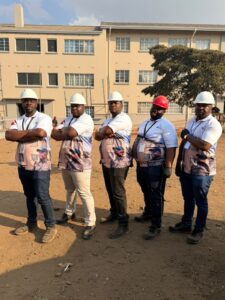
A-Team- The ED AID 1 projects team pose in front of Matapi Flats
“We are in line with all the policies to push the urban modernisation agenda,” Dr Njanji said before leading the delegation on a floor-by-floor inspection of the construction site.
The project addresses long-standing infrastructural decay at the 58 hostel blocks in Mbare, which were originally built for single dwellers but now suffer from severe overpopulation.
City of Harare Director of Housing and Acting Town Clerk, Edmore Nhekairo, outlined the administrative hurdles of managing the high-density area.
“The challenge really has been the management of these flat units,” Nhekairo explained.
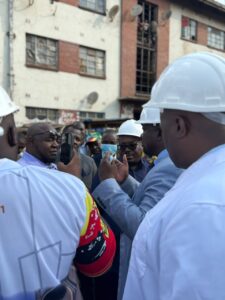
Parly members on site tour in at the Matapi Flats rehabilitation projects in Mbare today
“They were meant for single people, but over the years they are now overcrowded. This has overwhelmed the infrastructure, especially the sewage infrastructure.”
He noted that the city’s strategy involves a two-track approach: decanting residents into newly constructed flats on nearby land, while simultaneously refurbishing structurally sound existing buildings.
The committee inspected a block currently undergoing comprehensive rehabilitation through a public-private partnership with implementing partner ED Aid whose team is led by businessman Brian Pande.
City of Harare Regional Manager, Madam Farai Mtawa, said that the current works represent the fourth block renewed through such partnerships but noted this project is uniquely thorough.
“They are working on everything changing even the toilet seats,” Madam Mtawa said. She stressed that the immediate goal is to alleviate the reality where families have partitioned common rooms or occupied non-functional amenities due to space shortages.
“What we want is for people to just live decently,” she added.
The technical overhaul involves completely replacing broken water and sewer reticulation networks, fixing window panes and reinforcing structural safety features.
ED Aid Site Manager, Eng Nigel Chapendama, demonstrated the difference between the newly refurbished block and its untouched, dilapidated counterpart next door.
“If you look at the two buildings, you notice all the things that were basically damaged. Those buildings look identical to each other,” Eng Chapendama said. He pointed out that mesh framing was added to windows to prevent accidents and enhance resident safety, adding,
“We decided to place those things to protect the people of this community, and make sure that all the changes we are bringing will actually bring dignity, and a safe environment for them to stay.”
The Mbare inspection forms part of a wide parliamentary itinerary assessing urban regeneration projects across major cities, including the Sakubva Flats in Mutare, as Parliament works to formulate a comprehensive report to the House on funding, partnerships, and coordination requirements for national urban renewal.
