

HARARE – Representatives of the Swedish International Development Cooperation Agency (Sida) and UN-Habitat have visited the Glen View Integrated Waste Recovery Centre to assess progress on the ongoing construction works and engage stakeholders involved in the establishment of the facility, which is expected to strengthen waste management and create sustainable livelihoods in the community.
The delegation comprised Klara Williander, Programme Officer in the African Department, and Habane Hassan, Controller in the African Department, representing Sida, accompanied by Alex and Isaac from UN-Habitat.
The visit provided an opportunity for the development partners to assess progress towards operationalising the centre, appreciate the infrastructure being developed, engage directly with the beneficiaries and other stakeholders, and gain insights into the project’s contribution to sustainable waste management, environmental protection and livelihood enhancement.
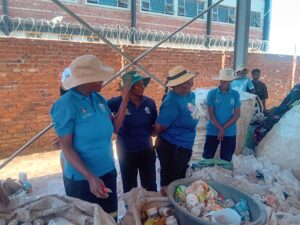
The centre, whose construction is underway, is already recording progress in its operational activities, with 20 waste reclaimers, comprising women and young people, working from the site. The beneficiaries are actively involved in recovering, purchasing, sorting and selling recyclable materials as part of efforts to establish a community-driven waste recovery and recycling enterprise.
A shelter has already been erected to provide a designated working space for the reclaimers as construction of other supporting infrastructure continues.
As part of efforts to promote waste segregation at source, the reclaimers have distributed colour-coded bins to households to facilitate the separation of biodegradable and organic waste, plastics, paper and cardboard, glass, and other recyclable materials.
Community Water Alliance (CWA) has also undertaken door-to-door community engagement campaigns to raise awareness about the initiative and secure community buy-in, ownership and meaningful participation.
Tricycles, whose operators have already undergone training, are expected to facilitate door-to-door collection of recyclable materials from households, strengthening the link between household-level waste separation and the centre’s recovery operations.
Beyond waste recovery, the facility is being developed as a community resource centre. A borehole has been drilled at the site to provide access to safe and potable water for the surrounding community.
Informal sector operators working in the vicinity are also expected to benefit from the ablution facilities being constructed at the centre.
Construction of toilets, offices and storerooms is currently underway, while preparations for the establishment of the Black Soldier Fly (BSF) processing facility are expected to commence soon.
The BSF component will provide an additional waste valorisation pathway by converting suitable organic waste into protein-rich insect larvae for animal feed and nutrient-rich frass for use as organic fertiliser.
A baling machine has also been availed to support the compaction and handling of recoverable dry waste materials, improving storage, transportation and preparation for recycling. This is particularly relevant to managing recyclable packaging materials generated by surrounding informal businesses, including carpentry operators.
A pelletising machine is also expected to support the conversion of suitable recovered materials into usable pellets.
The centre is expected to become fully operational by January 2027. Training on the operation and maintenance of the available machinery, including the baling and pelletising equipment, is expected to commence as part of preparations for full-scale operations.
Speaking during the visit, Plaxedes Muzimba, Chairperson of the waste reclaimers, took the delegation through their ongoing activities and highlighted the economic potential of organised waste recovery.
Muzimba revealed that members were currently earning between US$600 and US$900 per month through the collection and sale of recyclable materials. She expressed optimism that earnings would increase significantly once the centre becomes fully operational, particularly with the introduction of appropriate machinery, improved working conditions and tricycle-supported household collection systems.
She noted that the establishment of the centre would provide the reclaimers with a more secure and organised working environment while expanding their capacity to recover and market recyclable materials.
Dr Alexander Chileshe,the Project Manager and Head of Office for Zimbabwe and Zambia at the United Nations Human Settlements Programme (UN-Habitat) expressed optimism about the project’s potential to deliver wider benefits to the Glen View community, particularly through improved waste management and the creation of sustainable livelihood opportunities.
He observed that the initiative was expected to contribute significantly to improving waste management practices while strengthening the economic resilience of community members participating in the recycling value chain.
Community Water Alliance’s National Coordinator, Hardlife Mudzingwa, said the organisation’s role was primarily to build the capacity of the waste reclaimers and establish the necessary infrastructure to enable them to manage the enterprise sustainably.
Mudzingwa said CWA had also facilitated linkages between the reclaimers and relevant government authorities to support regulatory compliance and the formalisation of their business operations. The organisation had further connected beneficiaries with technical experts to strengthen their knowledge of waste management, enterprise development and business management.
He emphasised that CWA’s approach was to establish a self-sustaining community-owned initiative rather than maintain permanent control of its operations.
“Once the centre is fully operational and the beneficiaries are adequately equipped with the necessary skills and resources, CWA will step back and allow them to run the centre independently,” he said.
Mudzingwa urged the beneficiaries to prioritise unity, collective leadership and shared responsibility, warning that internal power struggles could undermine the progress already achieved.
Other stakeholders who attended the visit included Ward Councillor Charles Chidhagu, District Coordinator Kudakwashe Mupingashato, Henry from ActionAid and members of the media.
The Glen View Integrated Waste Recovery Centre is expected to provide an integrated approach to waste management by combining source separation, material recovery, recycling, organic waste processing and livelihood development. Its operationalisation is anticipated to strengthen community participation in the circular economy while demonstrating the potential of locally driven solutions to urban environmental challenges.
