
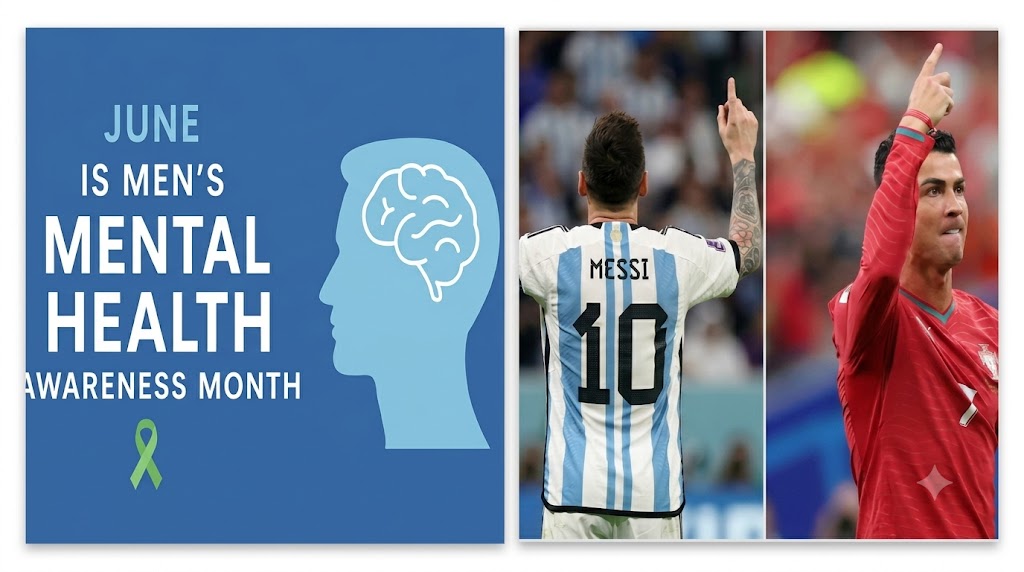
Opinion by Nigel Pfunde
The month of June is Men’s Mental Health Month, a time when we are reminded that many men carry stress and frustration in silence rather than talk about it. That silence matters because unprocessed emotion does not disappear. It often reappears as aggression and sometimes the smallest debates trigger and set it off!
Sport is supposed to be a unifying factor that propels social life forward positively. That’s why we have social soccer leagues and kumaboozer- supposedly chill places where men have conversations over several issues, with a bit of cheer from the fairer sex.
In Zimbabwe, football has long been a common language in kombis, workplaces and shebeens, bringing together people across tribe, class and politics.
I ain’t much of a football fan lately. My love for the game died with Reinhard Fabisch and the “Dream Team that never was” – the team that disappointed us with all that beautiful football and no results.
Getting back to why I took pen to paper, or rather fingers to keyboard: the current frenzy over who is the greatest player between Lionel Messi and Cristiano Ronaldo is testing that unity. The risk is not just to hurt feelings. It’s the social fabric itself.
The Messi-Ronaldo debate has moved far beyond football talk. In Harare and across the country, it has become an identity marker.
I’ve noticed that in most WhatsApp groups, the “who is the G.O.A.T” debate has caused fractures. Friendships sour and a supposedly reasonable discussion collapses into insults.
When emotion takes over, reason leaves the room. We’re in the month of June, and for men who already bottle up their struggles, a trivial debate can become the outlet for deeper frustration, they tend ‘kudhipisa'(going to the extremes).
There is a documented link between football fanaticism and violence, both in stadiums and at home.
Just last month, the Ministry of Sport condemned violence that forced the abandonment of a Premier Soccer League match between Hard Rock FC and Dynamos at Chahwanda Stadium in Kwekwe. Seven supporters ended up in hospital after chaos erupted inside and outside the venue. ZIFA and the Premier Soccer League made it clear that football must remain a safe, family-friendly and unifying space, not a battleground. Supporters were urged to embrace tolerance and respect.
Hooliganism undermines the values sport seeks to promote, but this Messi-Ronaldo debate feels like cyber hooliganism, if I’m allowed to invent that word.
This is not new! Research on spectator violence in Bulawayo Metropolitan Province found that hooliganism, tribalism, frustration and escapism drive aggression at matches. Seventy percent of participants said matches represent historical and ethnic conflicts, and 86% of referees noted that frustration and escapism lead spectators to vent anger through sport. The 2014 death of Bosso fan Thembelenkosi Hloli at a Dynamos-Highlanders match easily comes to mind.
The danger now is that the Messi-Ronaldo argument is reproducing the same dynamics on a smaller, more personal scale.
I’m not saying women aren’t caught up in this debate, but my focus is on men. When they cannot separate identity 01from a footballer’s performance, they carry that anger home.
International studies show domestic abuse incidents rise after football matches, with a 5% increase every two hours for the first four hours post-game, peaking 10 to 12 hours after kick-off. Alcohol is a key factor, but the pattern is clear: the game becomes a release valve for emotions that should be processed elsewhere.
My friends and relatives living and working in the United Kingdom have told me of a certain brand of beer (name withheld) which has become to be known as ‘wife beater’!.
I have seen guys drinking that at local joints during this World Cup and it is my hope and prayer that this ‘wife beater’ wont be triggered by the Messi-Ronaldo thingy and spill at home where they might want to ‘score’ more than Ronaldo with blows on the wife ‘s face .
Here in Zim, where conversations around men’s mental health are still limited, the risk is that arguments over GOAT status become a mask for deeper frustrations that end in physical fights among peers and, in some cases, violence against partners and workmates.
Sport only unites when we remember it is a game. The Messi-Ronaldo debate can be enjoyable if it stays in the realm of statistics, goals and memories. It becomes destructive when it turns into a proxy war for ego, pride and unresolved stress. Football authorities, clubs and supporters’ associations have a role to play in promoting discipline and respect, but the first responsibility lies with individuals to recognise when a debate is no longer about football.
If we want sport to continue building communities rather than breaking them, we need to treat Men’s Mental Health Month as more than a slogan. Men must be encouraged to talk, to walk away from toxic debates, and to see football as entertainment, not a measure of self-worth. Otherwise, the beautiful game risks becoming ugly and another source of the violence it was meant to help us escape.
As I sign of in a light hearted note I figuratively say the ‘goat’ issue has become a challenge in Zimbabwe with two prominent businessmen languishing in prison over a goats scandal and a popular youthful rapper Maskiri also brushing with the law over a goat related scandal although he was eventually let off the hook!
