
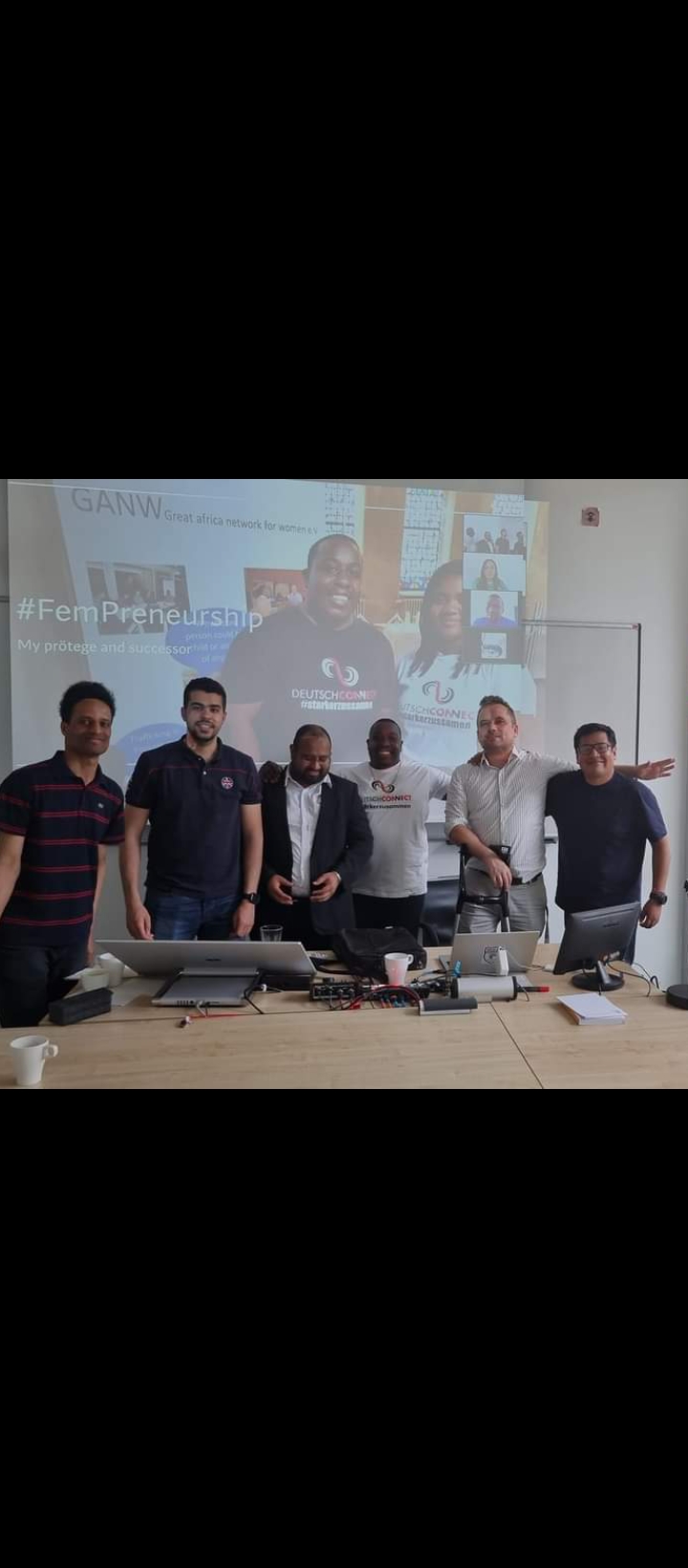
By Nigel Pfunde
Munich- Award-winning entrepreneur Kumbirai Chipadza has revealed how German apprenticeships are creating a new pathway for Zimbabwe’s unemployed youths and why it’s a win-win for both countries
When 19-year-old Tapfuma left Zimbabwe for Germany four years ago, his parents worried they might never see him succeed. Today, at 23 he’s a qualified Mechatronics Engineer working at BMW in Munich, earning over €3,500 per month and regularly sending money home to support his siblings’ education.

“Thank you Mr. Chipadza,” Tapfuma recently told Kumbirai Chipadza, founder of Deutsch Connect.
“I can now help my parents take care of my siblings while doing a job I love in the most beautiful city of Munich where I can watch Bayern Munich play.”
Tapfuma’s story isn’t unique. It’s part of a growing movement that’s challenging the traditional narrative of African migration—one that Chipadza calls “Brain Gain, not Brain Drain.”
Seven Years of Building Bridges
Sitting in his office in Germany, Chipadza reflects on seven years since founding Deutsch Connect, an organization that has placed over 100 Africans—many of them Zimbabweans in German apprenticeships, universities and companies.
“October 23rd marks our seventh anniversary,” Chipadza says his voice carrying both pride and humility.
“It’s been a remarkable journey complete with success and failure, victories and disappointment.
But what keeps me going are the lives we’ve touched—the stories of young Zimbabweans who now have careers, dignity and the ability to support their families back home.”
The accolades have followed. In 2022, Deutsch Connect was voted Ortel African Business of the Year in Germany. Chipadza was selected by the German government through the AGYLE Programme as one of just 40 African and German young business leaders tasked with accelerating economic cooperation between the two regions.
He has received grants from the State of Baden-Württemberg and has been chosen by the prestigious German Accelerator for international market entry into India.
But ask him about his proudest achievement, and Chipadza doesn’t mention awards.
“It’s the 30-plus young women who came to Germany through us as au pairs, social year volunteers, and healthcare apprentices,” he says, his tone turning serious. “When COVID-19 hit and most people in Germany were scared to go to work, these women were on the frontlines. They cared for the sick. They comforted the dying. They showed up every single day.”
He pauses:
“Chido, Memory, Faith, Precious, and others you are heroes. It’s not a story you’ll read in mainstream newspapers, but in their communities, these women are respected. They proved that when given the opportunity African talent doesn’t just fill gaps but it transforms systems.”
The Unemployment Crisis and the German Solution
Zimbabwe’s unemployment crisis is well-documented. Official figures hover around 20%, but youth unemployment tells a grimmer story, with estimates suggesting up to 90% of young people are either unemployed or underemployed in the informal sector.
Meanwhile, Germany faces a different crisis: a critical labor shortage. By 2030, Germany is projected to have a shortage of 3 million skilled workers. Currently, 163 occupations are classified as having acute labor shortages—from nurses and engineers to IT specialists and hospitality workers.
“It’s the perfect mismatch,” Chipadza explains. “Zimbabwe has talented, ambitious young people with limited local opportunities. Germany has well-paying jobs but not enough people to fill them. The question isn’t whether there’s opportunity—it’s whether we can build the bridge effectively.”
That bridge is Germany’s Dual System of apprenticeships, known locally as “Ausbildung”—a model that’s virtually unknown in Zimbabwe but could revolutionize how young Zimbabweans approach careers.
What Is an Apprenticeship, and Why Should Zimbabweans Care?
Unlike traditional university education, German apprenticeships combine classroom learning with on-the-job training. Students earn while they learn—typically €800 to €1,200 per month during their 2-3 year training period.
“Let me be clear,” Chipadza emphasizes. “This is not volunteering. This is not charity. From day one, apprentices are paid employees. They receive salaries, benefits, vacation days—everything a regular worker gets. And 70% of apprentices are offered full-time positions after completing their training, typically earning €2,500 to €3,500 per month or more.”
The contrast with Zimbabwe’s situation is stark. A university graduate in Harare might spend years looking for work, often accepting unpaid internships or jobs paying a fraction of the living wage. Meanwhile, a Zimbabwean apprentice in Germany earns a livable salary from month one, gains internationally recognized qualifications, and builds a professional network in Europe.
There are over 300 apprenticeship programs available, spanning healthcare (nursing, elderly care), engineering (mechatronics, automotive), IT (software development, cybersecurity), hospitality (chef, hotel management), and trades (plumbing, electrical work).
“The beauty of the German system is that it values practical skills as much as academic degrees,” Chipadza says. “You don’t need straight A’s. You need commitment, willingness to learn, and basic German language skills. That’s it.”
The Language Barrier—and How to Overcome It
The most significant hurdle?
Language. To qualify for apprenticeships, candidates need B1-level German—roughly equivalent to intermediate proficiency.
“I won’t lie to you,” Chipadza says. “Learning German is hard work. But it’s achievable. With focused study, most students can reach B1 in 6 to 12 months. And we’re making it easier.”
Deutsch Connect has just launched a new initiative: partnering with Zimbabwean schools to become German Language Schools. Ten schools across Zimbabwe will begin offering certified German language courses in January 2026, allowing students to learn German while still in secondary school.
“Imagine a Form 4 or Form 6 student graduating not just with their O or A Levels, but also with B1 German certification,” Chipadza explains. “They’re immediately eligible for apprenticeships. No gap year, no waiting. Straight from school to earning in Germany.”
The program costs families between US$2,000 and US$3,500 total—covering German lessons, placement in Germany, and airfare. Once in Germany, apprentices earn that back within three months of work.
Brain Gain, Not Brain Drain: The Win-Win Model
The phrase “brain drain” has haunted African development discourse for decades—the idea that Africa’s best and brightest leave and never return, depleting the continent of talent.
Chipadza rejects this framing entirely.
“Brain drain assumes migration is a zero-sum game—that if Zimbabwe loses a nurse, we just lose. But that’s not how it works in practice.”
He outlines what he calls the Brain Gain model:
For Zimbabwe:
Remittances: Zimbabweans in Germany send money home, supporting families and local economies. The World Bank estimates that remittances to Zimbabwe exceeded US$1 billion in recent years.
Skills transfer: Many return after 5-10 years with advanced skills, international networks, and capital to invest.
Reduced local unemployment pressure: Every person employed abroad is one less person competing for limited local jobs.
Diplomatic ties: Zimbabweans in Germany become cultural ambassadors, strengthening people-to-people connections.
For Germany:
Skilled workers: Addresses critical labor shortages in healthcare, engineering, and other sectors.
Cultural diversity:
African workers bring fresh perspectives, innovation and language skills.
Economic growth: More workers = more productivity = stronger economy.
For the individuals:
Dignity: Earning a living wage, building a career, supporting families.
Options: After gaining German/EU work experience, many can choose where to work—Germany, Zimbabwe, elsewhere.
Networks: Access to global opportunities they’d never have staying home.
“This isn’t about leaving Zimbabwe forever,” Chipadza insists. “It’s about creating options. Some will stay in Germany long-term. Others will return with skills and capital to start businesses here. Both outcomes are wins.”
He points to Tinashe, a Zimbabwean chef now working on an island in the North Sea. “Tinashe told me, ‘I work in a beautiful environment and the food I cook is eaten by world leaders,'” Chipadza recalls. “But he’s also planning to open a restaurant in Harare one day, using what he’s learned in Germany. That’s Brain Gain.”
The Stories That Keep Him Going
Beyond the statistics and policy arguments, Chipadza returns repeatedly to individual stories—because that’s what this work is really about.
There’s Engineer Caroline Rukasha, who relocated from Ukraine due to war and told him: “Deutsch Connect opened the doors for me in Germany. After relocating from Ukraine due to war, they guided me to continue my studies and pursue a professional path that opened incredible opportunities.” Caroline went on to complete her Master’s in Aerospace Engineering and Computer Science and has worked at BMW, Siemens, Schaeffler, and Adidas.
And there are the 30-plus women who became healthcare heroes during COVID-19, working on the frontlines when others stayed home.
“These aren’t just success stories for our portfolio,” Chipadza says quietly. “These are real people whose lives have fundamentally changed. They’re not just surviving—they’re thriving. And they’re showing the world what Zimbabwean talent can do when given the chance.”
The Challenges: Visa Delays, Bureaucracy, and Setbacks
Chipadza is candid about the obstacles. Seven years in, he’s seen plenty.
“We’ve lost apprenticeship partnerships that would have placed 20 candidates a year due to miscommunication. We’ve watched German embassies delay visas for months, sometimes crushing dreams right before intake deadlines. We’ve seen immigration laws change overnight, rendering months of work obsolete. We’ve had qualified candidates fail to secure placements despite doing everything right.”
There are also the operational challenges—teaching German remotely to students in areas with unreliable internet, navigating complex visa requirements across multiple countries, managing expectations when timelines stretch due to bureaucracy.
“There have been nights I wanted to shut it all down,” he admits. “Moments when the disappointments felt heavier than the mission. But then I get an email: ‘I got the job.’ Or ‘My visa came through.’ Or ‘I’m sending money home for the first time.’ And I remember why we do this.”
He’s learned to see setbacks as data, not verdicts. “Every lost deal taught us how to close the next one better. Every visa delay taught us to start earlier, prepare more thoroughly. We’ve become better because of the failures, not despite them.”
What’s Next: Expanding Access and Building Ecosystems
Looking ahead, Chipadza has ambitious plans for Deutsch Connect’s eighth year.
German Language in Schools: The pilot program with 10 Zimbabwean schools launches in January 2026. If successful, the model will expand to 50+ schools by 2028, making German language education accessible to thousands of students.
March 2026 Germany Trip: Deutsch Connect is organizing an exclusive educational tour for Zimbabwean school heads to visit German universities, vocational schools, and companies—including the Volkswagen factory and top tech firms. “School heads need to see it for themselves,” Chipadza says. “Once they understand how the system works, they become champions for their students.”
German Football Academy Trip: In partnership with Excellence Football Academy in Harare, Deutsch Connect and Schachter Sports will be bringing talented young Zimbabwean football players to Germany in April 2026 affording them opportunity to be scouted by top German coaches and clubs.
University Pathways: Beyond apprenticeships, Deutsch Connect is deepening partnerships with seven German universities—including SRH University, Constructor University, IU University in collaboration with SWS —to create scholarship pathways for Zimbabwean students pursuing bachelor’s and master’s degrees.
“The vision is bigger than placements,” Chipadza says. “We’re building an ecosystem where Zimbabwe and Germany aren’t distant trading partners—they’re co-creators of shared prosperity.”
Advice for Young Zimbabweans Considering Germany
For young Zimbabweans wondering if Germany is the right path, Chipadza offers this guidance:
1. Start learning German now.
“Don’t wait until you have a job offer. Start learning today. There are free resources—Duolingo, YouTube, language exchange apps. Even 30 minutes a day adds up. The sooner you start, the sooner you’re eligible.”
2. Be realistic about the commitment.
“This isn’t a get-rich-quick scheme. You’ll work hard. German work culture values punctuality, precision, and professionalism. But if you’re willing to show up and do the work, the rewards are significant.”
3. Don’t compare yourself to others.
“Social media makes it look like everyone’s succeeding overnight. Reality is messier. Some people get placed in three months. Others take a year. Focus on your own journey.”
4. Stay connected to home.
“You don’t have to choose between Germany and Zimbabwe. Send money home. Visit when you can. Share what you’re learning. Build bridges, not walls.”
5. Ask for help.
“You don’t have to figure this out alone. That’s what Deutsch Connect is here for. We handle the complex stuff—visas, placements, language training, cultural preparation. You focus on learning and showing up.”
A Message to Zimbabwean Parents
Chipadza also has a message for parents hesitant about their children going abroad.
“I understand the fear,” he says. “You worry they’ll leave and never come back. You worry about safety, about whether they’ll be treated well, about losing them to a foreign country.”
But he urges parents to reframe the question.
“Ask yourself: What opportunities exist for my child here, right now? If the answer is limited, then isn’t it your responsibility as a parent to help them access opportunities elsewhere—even if that means they leave temporarily?”
He points to Tapfuma’s parents, who now see their son thriving in Munich, sending money home, and planning to visit regularly.
“They didn’t lose their son. They gained a son who can stand on his own feet, support his siblings, and build a future. That’s not loss—that’s success.”
The Bigger Picture: Africa and Germany as Partners
Ultimately, Chipadza sees his work as part of a larger shift in how Africa and Europe relate to each other.
“For too long, the relationship has been unequal—charity, aid, dependency. But that’s changing. Africa has talent, innovation, and ambition. Germany has infrastructure, opportunity, and aging demographics. Both sides need each other. The question is whether we can build partnerships based on mutual respect and mutual benefit.”
He’s betting the answer is yes.
“When Tapfuma sends money home, his family wins. When he builds BMW engines, Germany wins. When he eventually returns to Zimbabwe with skills and capital, we all win. That’s what win-win looks like.”
And the stakes couldn’t be higher. With youth unemployment at crisis levels and traditional pathways to prosperity blocked, young Zimbabweans need alternatives—and fast.
“This generation doesn’t have time to wait for the economy to fix itself,” Chipadza says. “They need solutions today. German apprenticeships are one of those solutions. Not the only one, but a proven one.”
How to Get Started
For Zimbabweans interested in exploring opportunities in Germany, Chipadza outlines the process:
Step 1: Learn German
Enroll in a German language course. Deutsch Connect offers classes starting in November 2025, with a goal of reaching B1 within 12-18 months. Alternatively, students can join one of the partner schools offering German from January 2026.
Step 2: Get Certified
Take the official Institute exam to certify your B1 level. This is required for visa applications.
Step 3: Apply for Placements
Deutsch Connect matches qualified candidates with German employers or universities based on their interests and qualifications.
Step 4: Visa and Travel
Once placed, Deutsch Connect handles visa documentation, travel arrangements, and pre-departure orientation.
Step 5: Arrive and Thrive
Students arrive in Germany, begin their apprenticeships or studies, and start earning from day one.
“The process takes time,” Chipadza acknowledges. “But it works. We’ve done this 100+ times. We know what works and what doesn’t. Trust the process.”
A Final Word: Belief in Zimbabwe’s Youth
As our interview concludes, Chipadza returns to the theme that runs through everything Deutsch Connect does: belief in Zimbabwean youth.
“Our young people are not a problem to be solved,” he says firmly. “They’re an asset to be invested in. Give them the tools, the training, and the opportunity, and they will astonish you.”
He’s seen it firsthand—in Tapfuma’s engineering precision, in Caroline’s aerospace innovations, in the courage of 30 women caring for COVID patients, in Tinashe’s culinary artistry.
“Zimbabwe’s youth don’t lack talent or drive. They lack access. That’s what we’re changing. One student, one placement, one partnership at a time.”
Seven years in, with 100+ lives transformed and countless more in the pipeline, Kumbirai Chipadza and Deutsch Connect are proving that brain drain doesn’t have to be Africa’s story.
Brain Gain can be.
Kumbirai Chipadza is the founder of Deutsch Connect, an award-winning organization bridging African talent with German opportunities. Since 2018, Deutsch Connect has placed over 100 Africans in apprenticeships, universities, and companies across Germany, with a focus on creating sustainable, win-win partnerships between Africa and Europe.
SIDEBAR: By The Numbers
100+ Africans placed in Germany since 2018
€800-€1,200 Monthly earnings during apprenticeships
€2,500-€3,500+ Monthly salary after qualification
70% of apprentices offered full-time jobs
300+ apprenticeship programs available
163 occupations with labor shortages in Germany
3 million projected German worker shortage by 2030
30+ Zimbabwean women working in German healthcare
10 Zimbabwean schools becoming German Language Schools (January 2026)
7 years of Deutsch Connect bridging continents
