
By Tafadzwa Muranganwa
HARARE- After failing his O-Level examinations in 2024, Tanaka Mudzonga from Bocha in Marange turned to free online revision materials because he could not afford extra lessons. A few months later, after rewriting his examinations in November 2025, he passed.
“In 2024 I failed my O-Levels. Last year I repeated my studies and decided to use the internet for revision after failing to afford extra lessons. I am happy that I eventually managed to pass my examinations,” he said.
Tanaka’s experience reflects a growing national debate: is internet access becoming a hidden factor behind educational success in Zimbabwe?
Education experts increasingly argue that internet connectivity is no longer a luxury but an essential learning tool, providing access to research materials, online revision platforms, digital libraries and virtual learning opportunities. Yet access remains uneven, with thousands of learners in rural communities still disconnected from digital resources available to their urban counterparts.
A Pattern Emerging in the Data
Statistics from the Ministry of Primary and Secondary Education’s 2025 Annual Statistical Report reveal a striking pattern.
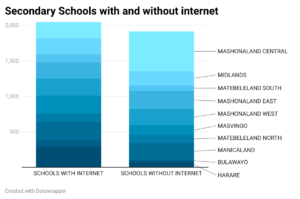
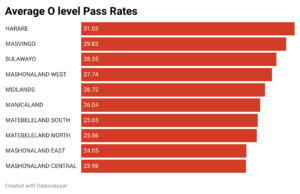
Harare and Bulawayo provinces recorded the highest levels of internet connectivity in secondary schools, with more than 70 percent of schools connected. Coincidentally, these provinces also recorded the highest average pass rates in the 2025 Zimbabwe School Examinations Council (ZIMSEC) O-Level examinations.
Sources:Ministry of Primary and Secondary Education Annual Statistical Report and Zimsec 2025 Provincial Average Pass Rates.
In contrast, Mashonaland Central and Matabeleland North provinces, where more than half of secondary schools remain without internet access, were among the country’s lowest-performing provinces in national examinations.
While the figures do not prove a direct causal relationship between connectivity and academic performance, they have intensified concerns among education stakeholders that access to digital learning resources may be increasingly influencing educational outcomes.
Internet and the Heritage-Based Curriculum

Ministry of Primary and Secondary Education’s Director of Communications and Advocacy, Mr. Taungana Ndoro.
Speaking in an interview, the Ministry of Primary and Secondary Education’s Director of Communications and Advocacy, Mr. Taungana Ndoro, said the observations mirror findings emerging from the ministry’s own monitoring systems.
“The debate that internet access in schools contributes to better educational performance aligns closely with what our own monitoring and evaluation systems are beginning to show. It reinforces exactly why expanding meaningful connectivity remains a central pillar of the ministry’s digital learning strategy,” said Ndoro.
He cautioned, however, against attributing examination success solely to internet access.
“Teacher quality, learning infrastructure, parental support and the availability of learning materials remain equally important factors influencing educational outcomes,” he said.
Ndoro explained that internet connectivity is now central to the implementation of Zimbabwe’s Heritage-Based Curriculum.
“Internet access is not treated as an add-on but as a critical enabler of our Heritage-Based Curriculum. The Ministry’s ICT in Education Policy Framework identifies connectivity as a prerequisite for delivering interactive digital content, virtual science laboratories and online continuous assessment tools,” he said.
The ministry is currently working with mobile network operators and development partners to expand digital infrastructure, particularly in under-served rural communities.
Rural Schools Left Behind
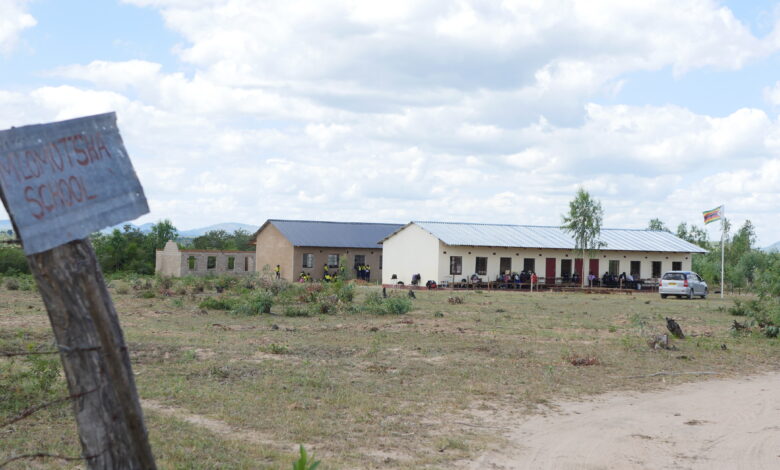
For many rural schools, however, internet access remains a distant reality.
A headmaster at a high school in Honde Valley, who requested anonymity, said connectivity could significantly improve learning outcomes where educational resources are scarce.
“The internet is very vital in improving the quality of education. Rural schools often have very few textbooks and high teacher-to-student ratios, so connectivity can make learning easier for students,” he said.
“The digital divide remains a major concern. We are not surprised that schools with no internet or erratic connectivity continue to record poor pass rates.”
He added that many rural learners enter examinations at a disadvantage because they have limited exposure to digital learning tools that are increasingly common in urban schools.
The challenges extend beyond students.
Josphat Chand, a teacher at Honde River Primary School, said poor connectivity affects his ability to access teaching materials.
“Most of the time I rely on WhatsApp to receive teaching material from colleagues in urban areas who have better internet access. Here, we are yet to be connected,” said Chando.
The Electricity Challenge
Even as government and development partners push to expand connectivity, another obstacle remains.
According to the Ministry’s 2025 Annual Statistical Report, 792 schools across Zimbabwe still do not have electricity. Although 2,693 schools,representing 77.27 percent of secondary schools, are electrified, the remaining 22.73 percent continue to face significant barriers to digital learning.
Without reliable electricity, internet connectivity alone cannot guarantee meaningful access to online educational resources.

Source:Ministry of Primary and Secondary Education 2025 Annual Statistical Report.
The report also shows that much of Zimbabwe’s school connectivity depends on satellite technologies due to inadequate broadband infrastructure in many parts of the country.
Harare dominates the distribution of broadband services, accounting for 26.78 percent of all ADSL-connected secondary schools, 29.5 percent of fibre-optic connected schools and 30.25 percent of LTE-connected secondary schools nationwide.
More Than Just Internet Access
Education analysts caution against reducing poor educational outcomes solely to internet shortages.
Secretary-General of the Amalgamated Rural Teachers Union of Zimbabwe, Robson Chere, said the urban-rural digital divide is a significant issue but only one of several factors affecting performance.
“There is an urgent need to address the yawning urban-rural internet divide so as to reduce disparities in pass rates,” said Chere.
“However, it would be an injustice to identify internet access as the only factor contributing to poor results. We know of schools, particularly in rural areas, where classes have more than 50 learners due to teacher shortages.”
South Africa-based educationist and university lecturer Danmore Chuma echoed similar concerns.
“In Zimbabwe, many teachers avoid working in rural areas because of poor working conditions. As a result, some schools end up relying on less qualified teachers, which contributes to lower pass rates,” he said.
A Growing Educational Divide
The available evidence does not prove that internet access directly causes improved examination performance. However, it does reveal a consistent pattern: provinces with stronger digital infrastructure generally record better educational outcomes than those where large numbers of schools remain disconnected.
As Zimbabwe accelerates its digital transformation agenda, the challenge extends beyond simply connecting schools to the internet. Ensuring reliable electricity, improving teacher deployment, strengthening digital literacy and distributing educational resources more equitably may prove just as important.
For learners like Tanaka Mudzonga, internet access opened a pathway to academic success. For thousands of others in disconnected schools across Zimbabwe, that opportunity remains out of reach.
Disclaimer:Tafadzwa Muranganwa is a NUST/HRE POLY,BTech MassCom student.The article is a project under the Data Journalism module and hence this publication sorely reserves the rights of the story to the aforementioned parties.
