
By Nigel Pfunde
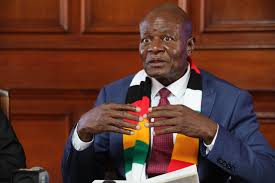
HARARE — LOCAL Government and Public Works Minister Daniel Garwe says the Second Republic under President Emmerson Mnangagwa recorded decisive economic and developmental gains in 2025, laying what he described as “irreversible foundations” for Zimbabwe’s transformation into an upper middle-income economy by 2030.
Garwe said the year marked a critical turning point in the country’s national development trajectory as Government policy moved decisively from economic stabilisation to full-scale implementation with emphasis on productivity, enterprise development and disciplined wealth creation across all sectors of the economy.
In an opinionated assessment of the year’s progress, the minister dismissed claims that President Mnangagwa’s call on citizens to “make money” was rhetorical or populist arguing instead that it constituted a deliberate and structured policy doctrine aimed at entrenching a national culture of work, innovation and value addition.
“The Second Republic has in 2025 demonstrated that economic growth is not an abstract concept but a direct outcome of hard work, innovation and production,” Garwe said.
Adding:
“The President’s message is a national mandate and not a political slogan. It speaks to the responsibility of every Zimbabwean to participate meaningfully in building the economy.”
Garwe said Government interventions during the year were deliberately aligned to unlock productivity at grassroots level, citing accelerated infrastructure development, devolution funding, support for local authorities, housing delivery and the rehabilitation of roads, water systems and public amenities as key enablers of economic activity.
This includes the work did by Geo Pomona Waste Management .
He said the local government sector had increasingly become a driver of development rather than a passive administrative arm, with councils being capacitated to support industrial sites, markets, small-scale enterprises and housing projects that stimulate local economies and job creation.
“The focus in 2025 has been to ensure that development is visible, measurable and impactful at community level. Productivity begins where people live and work and that is why devolution and local infrastructure have been prioritised,” Garwe said.
The minister also pointed to gains in agriculture, mining, manufacturing and construction.
He said policy consistency, investment friendly reforms and improved coordination across Government had strengthened confidence and reduced economic vulnerabilities.
According to Garwe, the shift towards value addition and beneficiation was beginning to yield results, with increased local processing and expanded participation by indigenous entrepreneurs particularly youths and women.
He said Vision 2030 remained firmly on course, anchored by the National Development Strategy 1 (NDS1) and reinforced by a governance framework that emphasises accountability, fiscal discipline and production led growth.
“Vision 2030 is no longer an aspiration; it is a structured pathway that is being walked step by step brick by brick.
” What we saw in 2025 is evidence that the foundations are firm and irreversible,” Garwe said.
He urged Zimbabweans to remain focused, disciplined and united warning that economic transformation requires sustained effort, patience and collective responsibility.
“The Second Republic has set the direction. The task before us now is to consolidate the gains, deepen productivity and ensure that no one is left behind as we march towards an upper middle-income economy,” Garwe said.
